
Virginia Marriage License Records
Virginia marriage licenses are issued by Circuit Court clerks at courthouses across the Commonwealth. You can apply at any circuit court in Virginia, not just the one in your county or city. Both people who plan to marry must appear in person, bring valid photo ID, and provide Social Security numbers along with their parents' full names. The fee is $30 and the license is valid for 60 days. This page covers where to go, what to bring, how to search for existing Virginia marriage records, and how to get certified copies from the court or the state vital records office.
Virginia Marriage License Overview
Where to Get a Virginia Marriage License
Circuit Court clerks issue all marriage licenses in Virginia. Under Virginia Code § 20-14, only a clerk or deputy clerk of a circuit court can issue a marriage license. Virginia has 95 counties and 38 independent cities, each with its own circuit court. You can use any one of them. There is no residency requirement. A couple living in Richmond could walk into the Loudoun County courthouse and apply there without any issue. The county or city where you apply does not have to match where you live or where the ceremony will take place.
The Virginia Department of Health Office of Vital Records is a separate office from the circuit courts. VDH does not issue new marriage licenses. What it does is maintain the central registry of all Virginia marriage records from 1853 to the present. Once the officiant fills out the completed license after the ceremony and returns it to the issuing court clerk, that clerk forwards the record to VDH. It becomes part of the statewide vital records system. The Virginia Judicial System website lists all circuit courts in the state with contact information, addresses, and hours.
Virginia has no waiting period and no blood test requirement. Most couples are in and out of the clerk's office within 30 minutes. A few jurisdictions offer online pre-application tools to help speed up the process when you arrive at the courthouse.
The VDH Office of Vital Records maintains the central state repository for all Virginia marriage records, with filings dating back to 1853. Certified copies can be ordered online, by mail, or in person at 8701 Park Central Drive, Suite 100, Richmond, VA 23227.
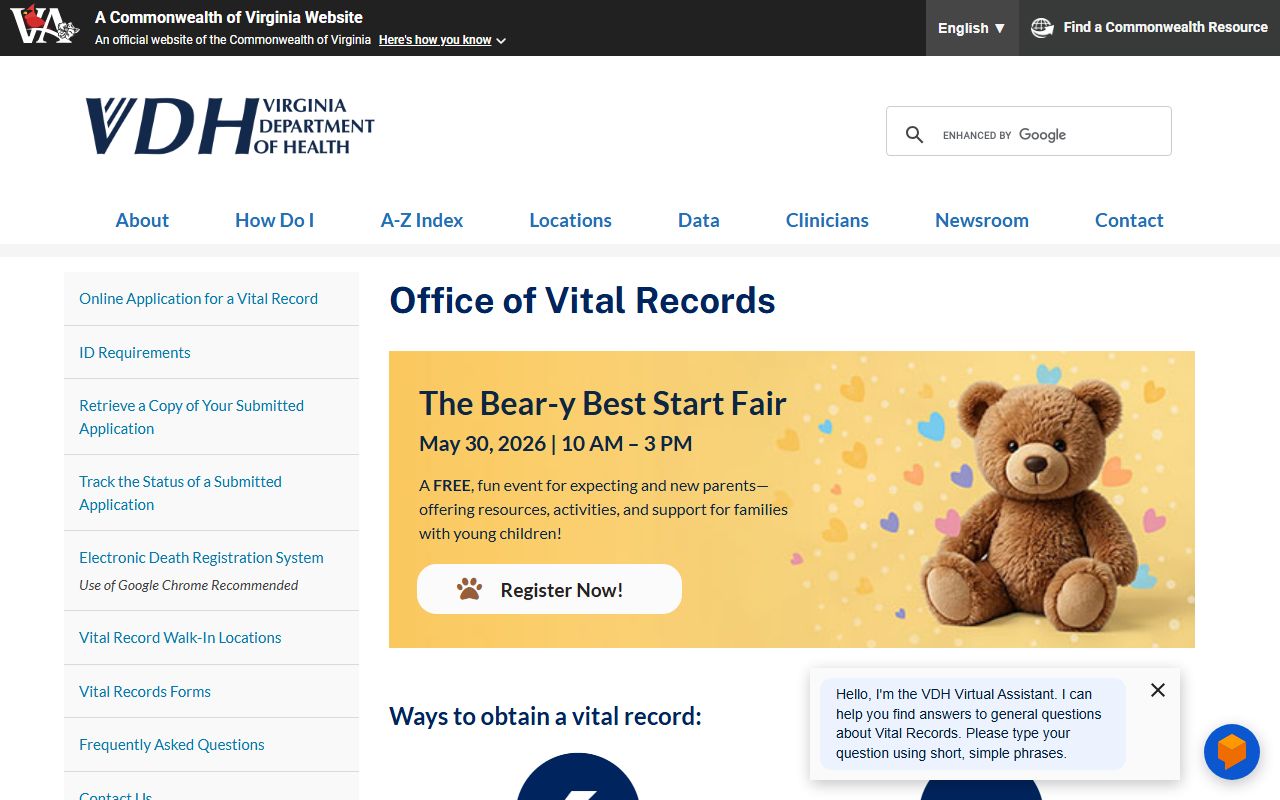
Walk-in service at VDH is available Monday through Friday, 7:00 a.m. to 4:00 p.m. VDH issues certified copies of marriage records but does not issue marriage licenses.
Note: The VDH Office of Vital Records and your local circuit court are two different offices. Marriage licenses come from the circuit court. Certified copies of the official marriage record can come from either.
Virginia Marriage License Requirements
Both people who plan to marry must show up at the clerk's office at the same time. You cannot send a representative. Bring a valid, unexpired government-issued photo ID. A driver's license, passport, or military ID all work. A state-issued photo ID card is also acceptable. Expired IDs are not. If you are not sure which ID types the specific court accepts, call ahead before you go.
You will need your Social Security number. You do not need to bring the physical card, just know the number. The clerk will also ask for the full names of your parents, including your mother's maiden name before she married. This is required by Virginia Code § 20-16, which sets out what information must be collected on the marriage license application. Write down your parents' full names before you visit the court to avoid delays.
What to bring to the courthouse:
- Valid, unexpired government-issued photo ID for both applicants
- Social Security numbers for both applicants
- Full names of both parents, including mothers' maiden names
- $30 in cash or a major credit card (check your specific court)
Age is a firm line. Virginia Code § 20-48 sets the minimum age at 18 with no exceptions. Virginia removed all earlier provisions that allowed younger people to marry with parental consent. Both parties must be at least 18 at the time they apply. Your photo ID serves as proof of age. If there is any question, bring a certified copy of your birth certificate.
The VDH vital records FAQ confirms that the Office of Vital Records does not handle new marriage license applications. Those go through your local circuit court clerk.
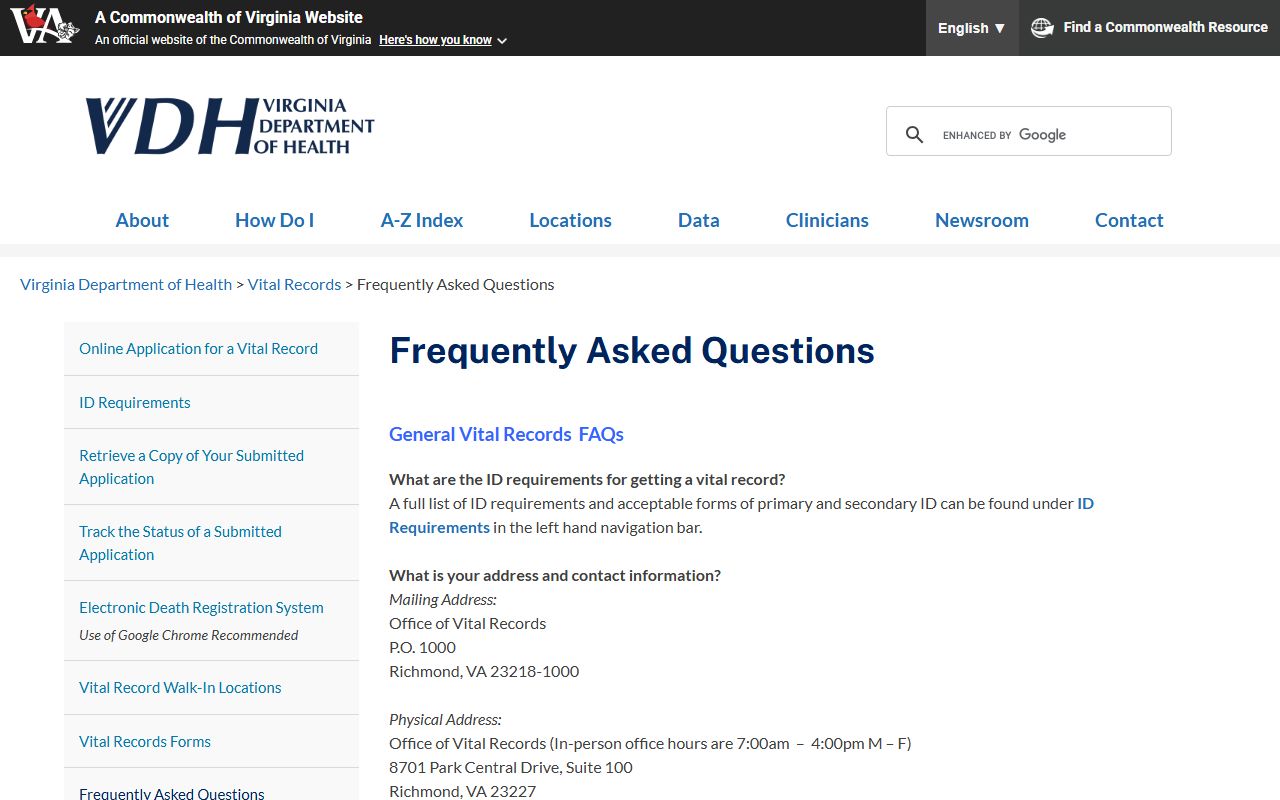
The FAQ also addresses ID requirements, certified copy fees, and contact information for VDH's customer care center at (804) 662-6200.
Marriage License Fees and Validity in Virginia
The marriage license fee is $30 at every circuit court in Virginia. Virginia Code § 20-15 establishes this as a license tax, part of which goes to the Virginia Department of Social Services for domestic violence services. Most courts accept cash and credit cards. A few charge a small processing fee for card payments. Fairfax County adds a 4% surcharge for Visa or Mastercard. Portsmouth accepts cash or debit and credit cards but not personal checks. Call your local court if payment method is a concern.
The license is valid for exactly 60 days from the issue date. Virginia Code § 20-14.1 is clear on this. If 60 days pass without a ceremony, the license expires. You would need to apply again and pay the $30 fee a second time. The ceremony must take place within the Commonwealth of Virginia. A license issued by a Virginia circuit court is not valid for out-of-state weddings.
The Virginia Judicial System website provides contact details for every circuit court clerk's office, including phone numbers and hours for confirming fee schedules before you go.
After the ceremony, the officiant must complete the marriage license form and return it to the issuing clerk's office. Norfolk, for example, requires return within 7 days. The clerk then records it and sends a copy to VDH.
Certified Copies of Virginia Marriage Records
Two offices provide certified copies of Virginia marriage records. The circuit court clerk who issued the original license keeps a copy on file and can produce certified copies for $2.50 each. This is the faster and cheaper route if you know which court issued your license. You can visit in person or send a mail request. Mail requests require you to include the names of both spouses and the approximate date of the marriage, along with a self-addressed stamped envelope. Same-day service is usually available for in-person requests.
The second option is the VDH Office of Vital Records, which charges $12 per certificate. They have records from 1853 to the present. You can apply online through their portal, by mail to P.O. Box 1000, Richmond, VA 23218-1000, or in person at 8701 Park Central Drive, Suite 100, Richmond, VA 23227. Phone: (804) 662-6200. For faster turnaround, use the expedited service by calling 1-877-572-6333 (press option 2) or going through VitalChek. Virginia DMV offices also provide certified copies at full-service locations, including service centers and 2Go mobile offices.
Note: If no record is found for your request at VDH, the $12 fee is still charged and a "No Record" letter is issued instead of a certificate.
Historical Virginia Marriage Records
Virginia has kept marriage records since 1853. The Library of Virginia holds marriage registers from 1853 to 1935 on microfilm, arranged alphabetically by county and then by city. Each register entry lists the date and place of the marriage, the full names of both parties, their ages, marital status, birthplaces, parents' names, the groom's occupation, and the name of the officiant. Microfilm is available for loan through interlibrary loan services. For marriages after 1935, contact VDH for certified copies or use subscription genealogy databases.
Records go back further than 1853 through other sources. Marriage bonds, church records, and ministers' returns document many marriages from the colonial period onward. The Library of Virginia holds a Marriage Records Card Index covering 1719 to 1898. FamilySearch has digitized many Virginia county marriage registers from 1853 to 1935 and made them searchable online at no charge. Virginia residents can access Ancestry.com free through the Library of Virginia's Finditva.com service using a public library card.
The University of Virginia library guide to Virginia vital records explains online access options for marriage records, including which years are covered by each database and how the 25-year privacy restriction affects what you can find.
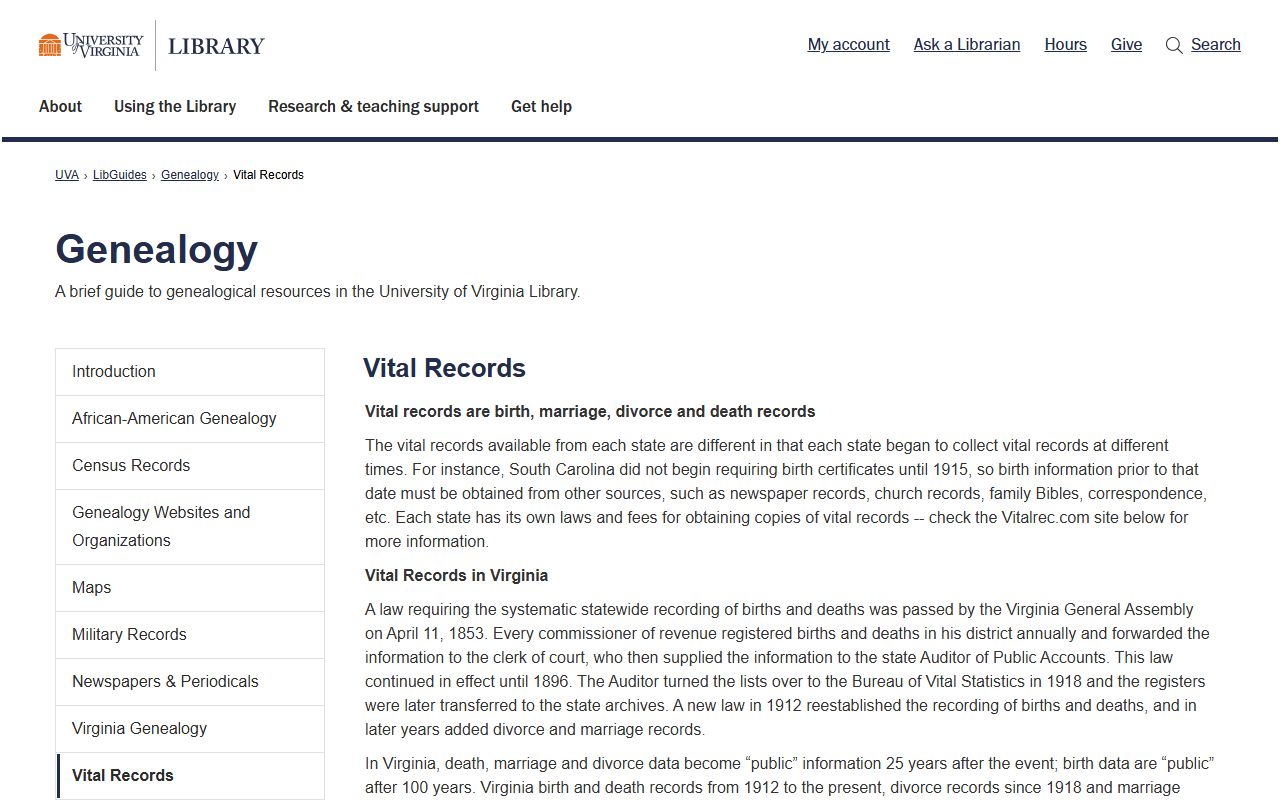
The guide notes that Virginia marriage records since 1936 are indexed on Ancestry, while records back to 1853 are available through the Library of Virginia and FamilySearch.
Virginia Marriage Records Access Rules
Virginia Code § 32.1-271 governs who can access vital records and when they become public. Marriage records are restricted for 25 years after the event. Within that period, only immediate family members can obtain a certified copy. Immediate family under Virginia law includes the spouses, their parents, grandparents, children, and siblings. Valid photo ID is required at the time of request. Aunts, uncles, cousins, and in-laws do not qualify. They must wait until the 25-year window closes.
After 25 years, marriage records become public information. Anyone can request them without stating a reason or showing a family connection. Social Security numbers on marriage records are always redacted from public copies, regardless of the record's age. This protection applies even after the record enters the public domain. The Virginia Freedom of Information Act establishes broad public access to government records, but vital records follow § 32.1-271's specific rules.
If you need a Virginia marriage certificate authenticated for use abroad, contact the Office of the Secretary of the Commonwealth after getting your certified copy from VDH. Reach them at authentication@governor.virginia.gov for information on apostilles and authentications.
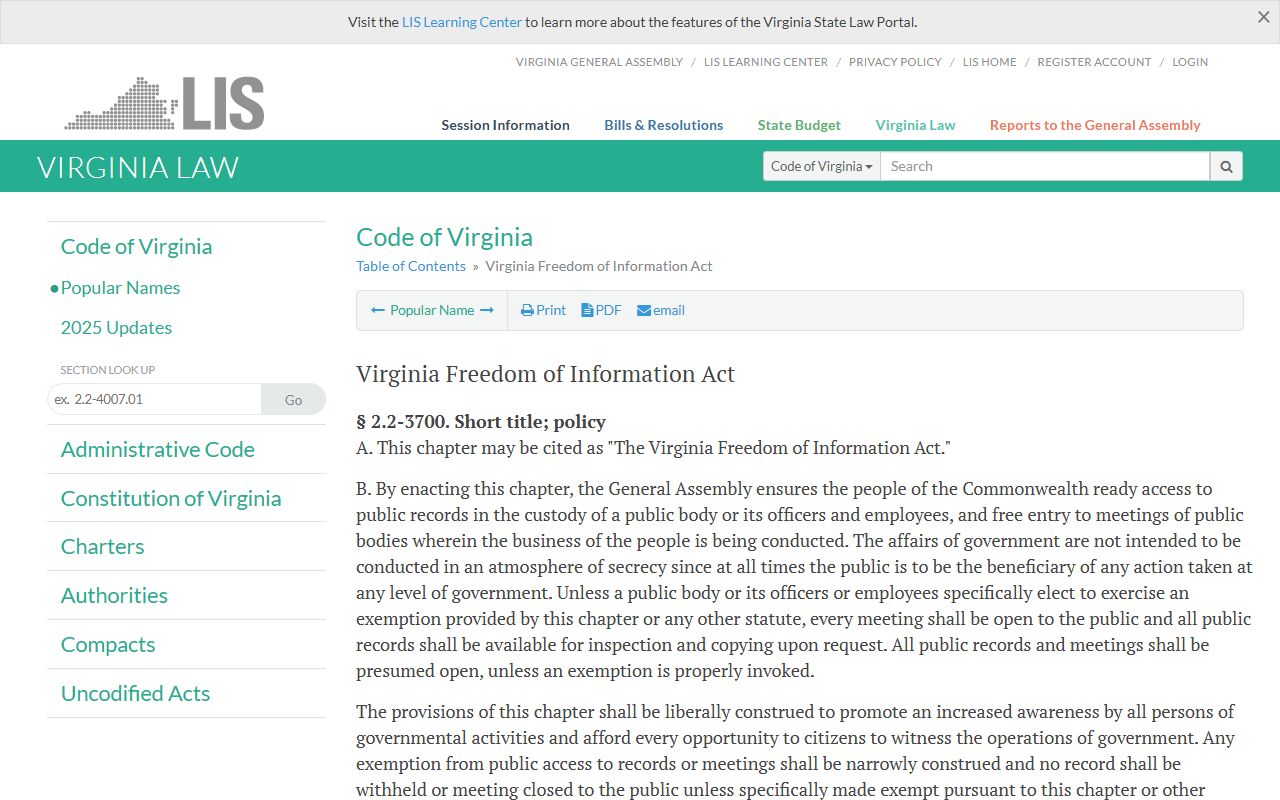
The FOIA establishes the general presumption of public access to government records in Virginia. Vital records are governed by § 32.1-271, which imposes the 25-year restriction before records become part of the public domain.
Who Can Officiate a Virginia Marriage
Virginia law under Code § 20-23 and § 20-25 sets out who may legally perform a marriage ceremony. Any ordained minister of any religious denomination may apply to be authorized by a local circuit court after showing proof of ordination. Out-of-state ministers who want to perform a single ceremony in Virginia must contact the circuit court in the jurisdiction where the wedding will take place. They need to provide proof of ordination, a valid ID, a letter describing the occasion, pay an authorization fee, and post a $500 bond. Processing can take several days, so plan ahead.
Civil officiants cover a wide range. Active and retired judges and justices at every level of the Virginia court system may perform marriages anywhere in the state without needing a separate court order. So may current and former members of the Virginia General Assembly, the Governor, the Lieutenant Governor, the Attorney General, and circuit court clerks themselves. Several cities maintain lists of marriage commissioners who perform ceremonies at or near the courthouse for a fee. Norfolk lists a commissioner available during business hours for $50 cash. Portsmouth has five commissioners and also allows the Clerk to perform ceremonies in the Clerk's Office for $75 cash.
Virginia's official tourism guide for getting married confirms there is no waiting period, no blood test required, and no witnesses needed for a Virginia marriage.
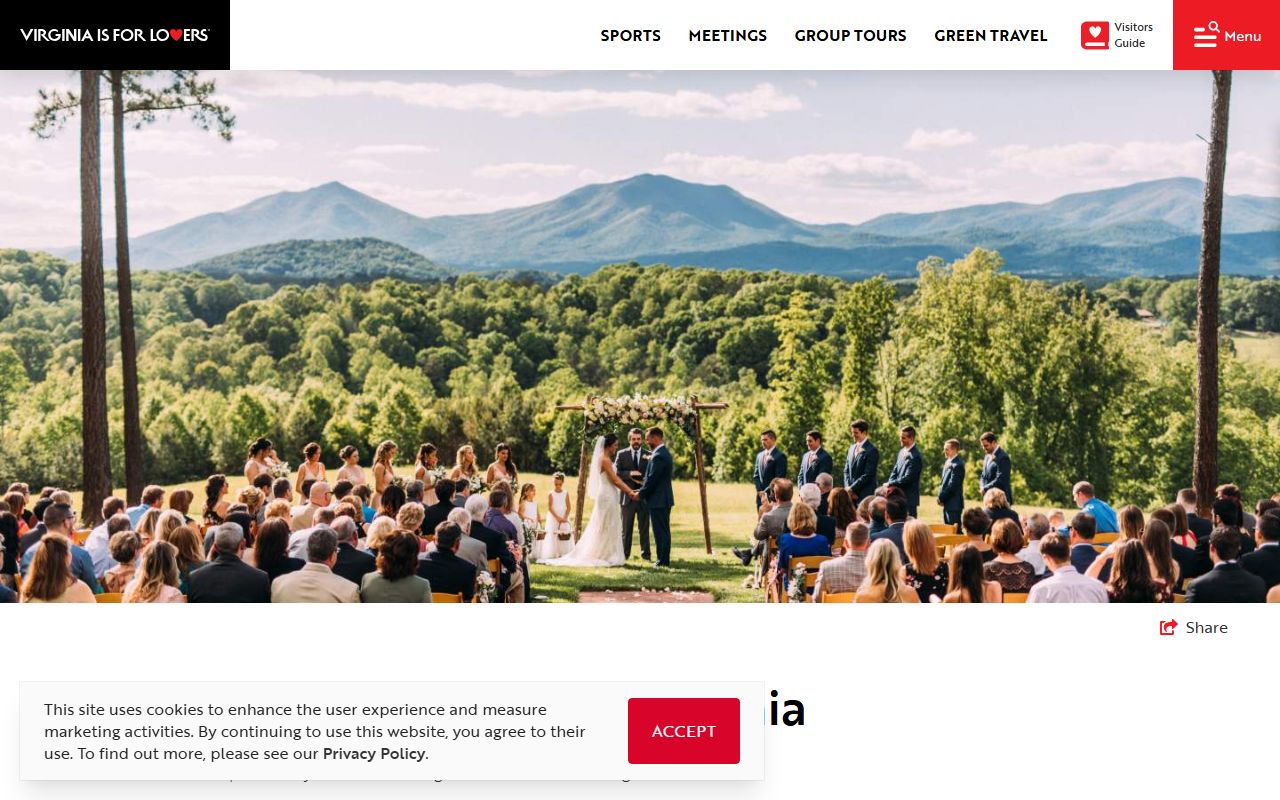
The guide lists the main requirements: valid ID, $30 fee, and both parties present. The license is valid for 60 days from issue and the ceremony must take place within Virginia.
Note: Under Virginia Code § 20-13.2, no clerk may deny a marriage license based on the sex, gender, or race of the applicants.
Virginia Marriage License Laws
Virginia marriage law is found in Title 20 of the Code of Virginia. The key statutes cover how a license is issued, who may perform the ceremony, what marriages are prohibited, and what happens to the records afterward. Under § 20-13, every marriage in the Commonwealth must be performed under a valid license and solemnized in the manner required by law. A ceremony without a license has no legal standing.
Section § 20-38.1 lists prohibited marriages. These include marriages where one party is already married, marriages between ancestors and descendants, and marriages between siblings, whether by whole blood, half blood, or adoption. A marriage between an uncle or aunt and a nephew or niece is also prohibited. These prohibitions are absolute and not subject to waiver. Section § 32.1-271 governs how the records are kept and accessed after the marriage takes place. Social Security numbers in marriage records are protected from disclosure in public copies regardless of how old the record is.
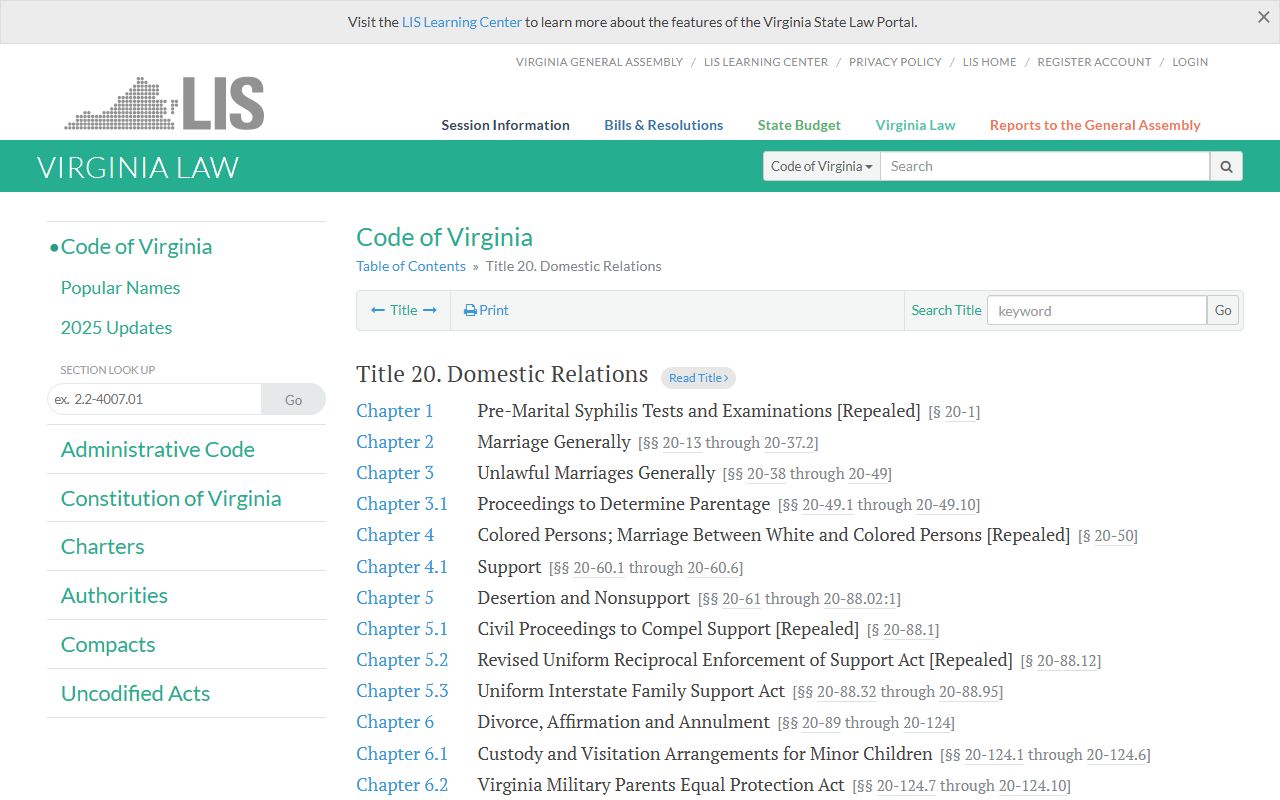
Title 20 of the Code of Virginia is publicly available through the Legislative Information System, where you can read the full text of every marriage statute in the Commonwealth.
Browse Virginia Marriage Licenses by County
Each of Virginia's 95 counties has its own Circuit Court clerk that handles marriage license applications. Select a county below to find courthouse contact details, local fees, and marriage record resources in that area.
Marriage Licenses in Major Virginia Cities
Virginia has 38 independent cities, each with its own circuit court. Select a city below to find the courthouse address, contact info, and marriage license details for that city.